Formula Student Gearbox Lubrication CFD Simulation
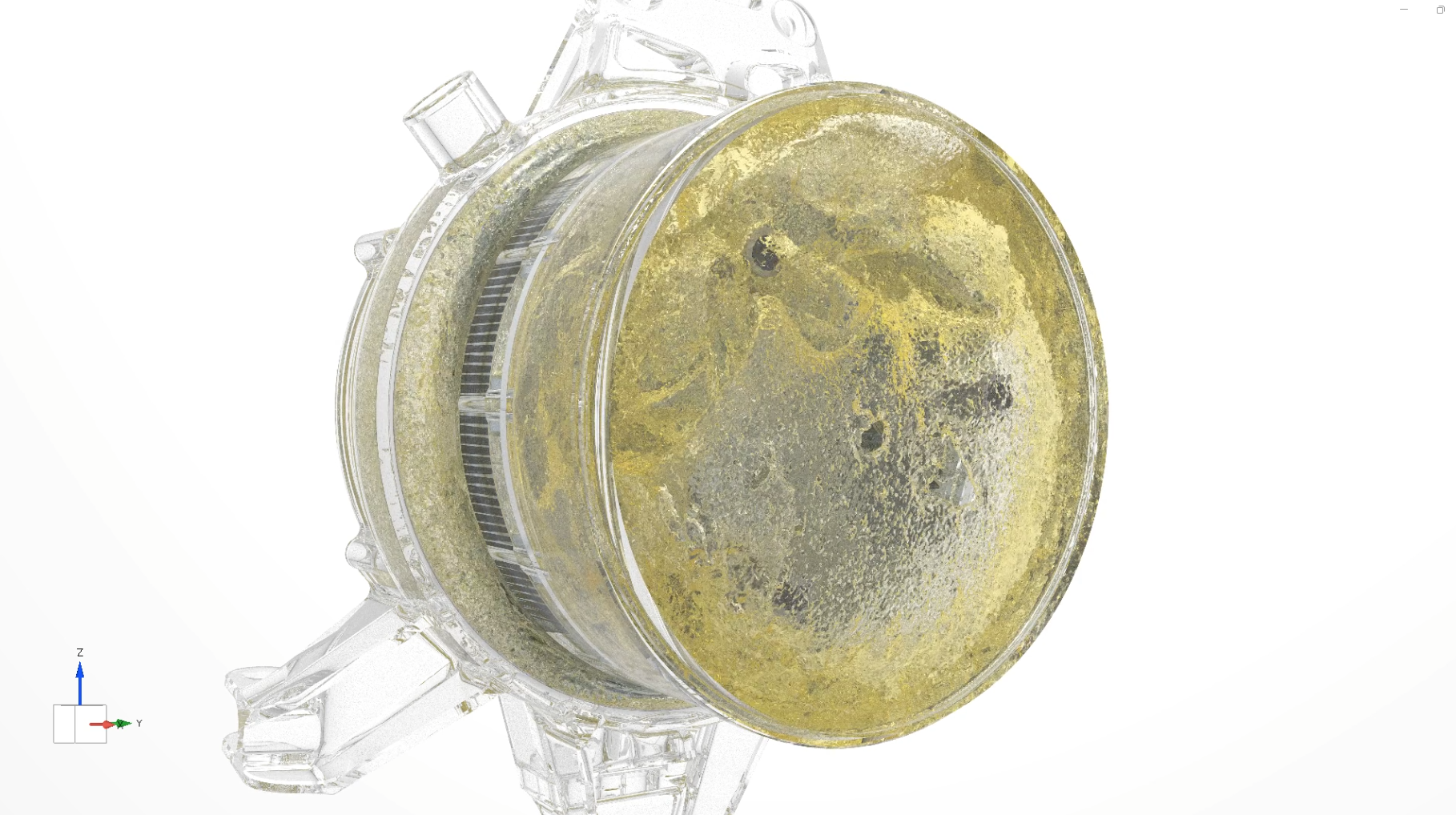
I worked with a colleague on developing an SPH simulation of our gearbox lubrication system. The main aim was to better understand oil distribution, churning losses and wetted areas inside the gearbox, while also exploring how SPH could support drivetrain design decisions.
Project write-up
As part of my work at Oxford Brookes Racing, me and my colleague worked together on an SPH simulation of the gearbox lubrication system, using CAD and information provided by our drivetrain section. The aim was to better understand oil behaviour inside the gearbox and eventually use the results to help inform decisions such as oil level, viscosity and lubricant distribution.
Unlike Volume of Fluid (VOF), which can require complex overset meshing to deal with rotating gears, Smoothed-Particle Hydrodynamics (SPH) is a meshless method where the fluid is represented by discrete particles. This makes it particularly useful for applications such as gearboxes with multiple fast-moving components, especially when combined with the DFBI kinematics solver in STAR-CCM+.
One of the first challenges was simply setting the correct oil volume. The SPH particles are seeded from a block which is intersected by the extracted gearbox volume. This meant that the height of the block had to be adjusted until the required oil volume in millilitres was achieved. Doing this manually was not very practical, so I wrote a CAD macro which used an iterative process to automatically calculate the required block height for a specified oil volume.
The final simulations contained up to 5.1 million SPH particles. A typical run took around 3 days, approximately 30,000 iterations, and covered just under 0.15 s of physical time, using a timestep of 1.86E-5 s. One of the main reasons for the computational cost was maintaining a suitable CFL condition with gears rotating at over 20,000 RPM.
The introduction of GPGPU acceleration in STAR-CCM+ 2510 on Linux made a big difference here, giving us approximately a 10x speed-up compared to CPU runs.
Post-processing also brought its own problems. With such a large number of particles and timesteps, saving the full solution data too frequently produced more data than the local workstation could reasonably handle afterwards. To get around this, the required scenes were exported while the simulation was running, rather than relying on post-processing the full transient dataset later.
The simulations can provide useful outputs such as churning losses, wetted surface area and transient oil distribution, which can then be used to understand how effectively the lubricant reaches different parts of the gearbox.
There are still some limitations to the method. STAR-CCM+’s current SPH solver works with a single continuum, meaning the oil-air interface itself is not resolved. The number of flow quantities available for analysis is also more limited than with finite-volume methods.
Read the gearbox post on LinkedIn↗